Getting there, timing and the evening
Wekalet El Ghouri show: what to expect
Where the Tanoura show is, how long the evening takes, what to wear, and what you'll see and hear, with the history of the building and the troupe.
See Tanoura show tickets on GetYourGuide ↗Quick answer
Plan for about four hours if you take the tour: a transfer each way and about two hours at Wekalet El Ghouri, an arts centre in a 16th-century caravanserai behind the Al-Azhar Mosque. The show is mostly in an open courtyard, so dress modestly and bring a layer for cooler evenings. The music and dance need no translation, and the booking calendar and your confirmation show the times.
Where the show is
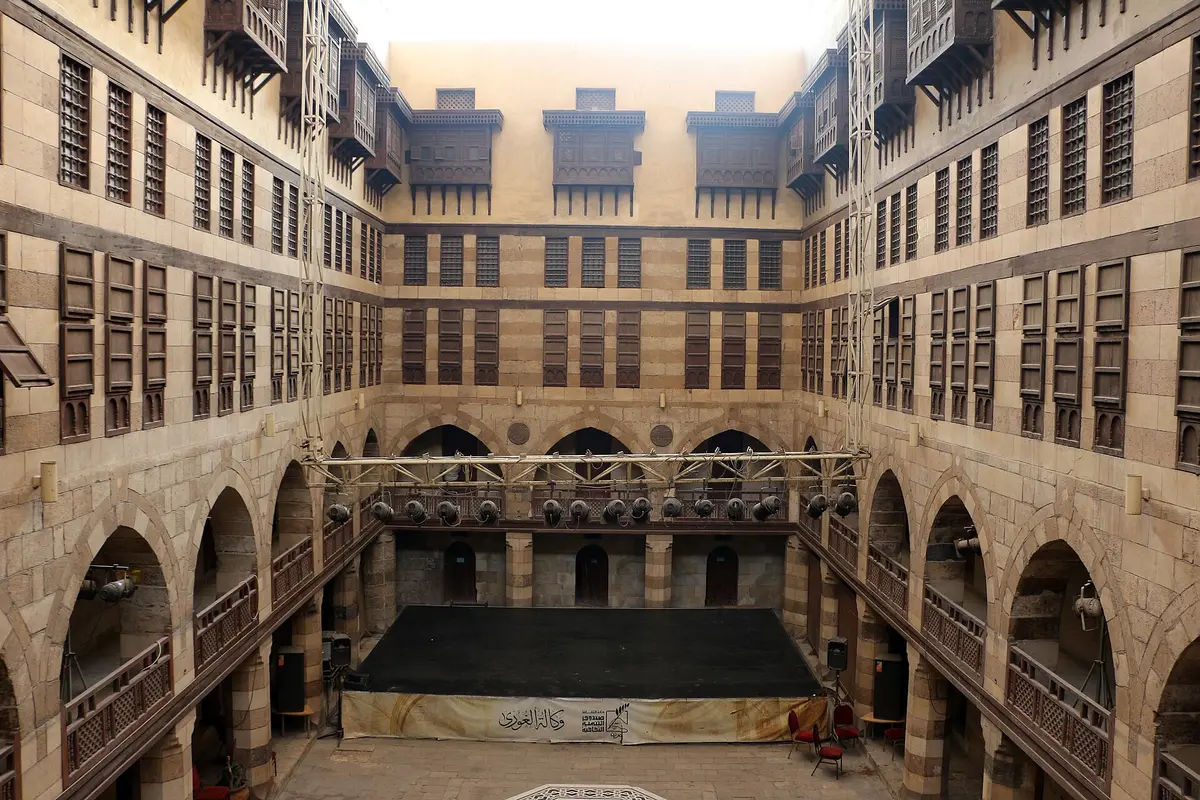
Wekalet El Ghouri, also written Wikala of al-Ghuri, is a caravanserai built in the early 16th century by Sultan Qansuh al-Ghuri, who took the throne in 1501 and died fighting the Ottomans in 1516. It stands in the Al-Azhar area of Islamic Cairo, on Mohamed Abdou Street behind the Al-Azhar Mosque. Today it is an arts centre run under the Cultural Development Fund of Egypt's Ministry of Culture, and the Tanoura show is one of its performances. The monument has a few names in English, so you will also see Wekalet El Ghoury and Wikalat al-Ghuri.
Getting there and back
With the tour, you are collected at your accommodation in Cairo or Giza and returned afterwards, and the itinerary lists about 45 minutes of transfer each way. Pickups from the airports and from several outer districts cost extra. If you go on your own, the address is Mohamed Abdou Street, behind the Al-Azhar Mosque. A major road, Al-Azhar Street, runs between the Khan el-Khalili bazaar and the Ghuri complex, so walking over from the bazaar means crossing it. Arrange your way back before the show starts.
How long the evening takes
The tour as a whole is listed at four hours. That is two transfers and about two hours at the venue, which includes the visit and the show. Sources give no fixed running time for the performance itself, and published start times differ between articles and visitor guides. Use the booking calendar and your confirmation for the pickup time, and don't plan anything else for that evening, because the transfers leave no slack for a late dinner booking. If you are going on your own, confirm the date with the venue before you set out, and ask how early the doors open.
Outdoors, with an indoor fallback in winter
The courtyard is open to the sky, as the photograph shows, and the show is mostly staged there. In winter it sometimes moves to the dome, an indoor hall. You can't pick between them when you book. Because of this, think of the evening as an outdoor event: bring a light layer in the cooler months, and wear comfortable shoes for stone floors. Musicians perform from the galleries above the stage, so look up as well as ahead.
Read next: Tanoura show Cairo: tickets and options
What to wear
Official advice for Egypt is to dress modestly, especially around mosques and in markets, and this part of Islamic Cairo has both. Covering shoulders and knees is a safe default for an evening here. The sources checked publish no dress code for the show itself. During Ramadan, whose dates change every year, the same advice asks visitors to avoid eating, drinking or smoking in public in daylight hours and to follow local dress codes.
- Shoulders and knees covered
- A light layer for cooler evenings
- Comfortable closed shoes for stone floors
- A scarf or shawl is handy if you plan to visit a mosque nearby
What you'll see and hear
The evening combines live music and the Tanoura dance. The musicians play instruments such as the daf frame drum, the oud and the ney flute, with singers, and one singer is described performing from a balcony. The dancer wears a wide, colourful skirt that flares into a disc as the spin builds, and tanoura is the Arabic word for skirt. Dancers usually add and spin extra skirts. In devotional use the spin runs anticlockwise, while a show for entertainment can turn either way. Accounts of the running order differ.
The building you're sitting in
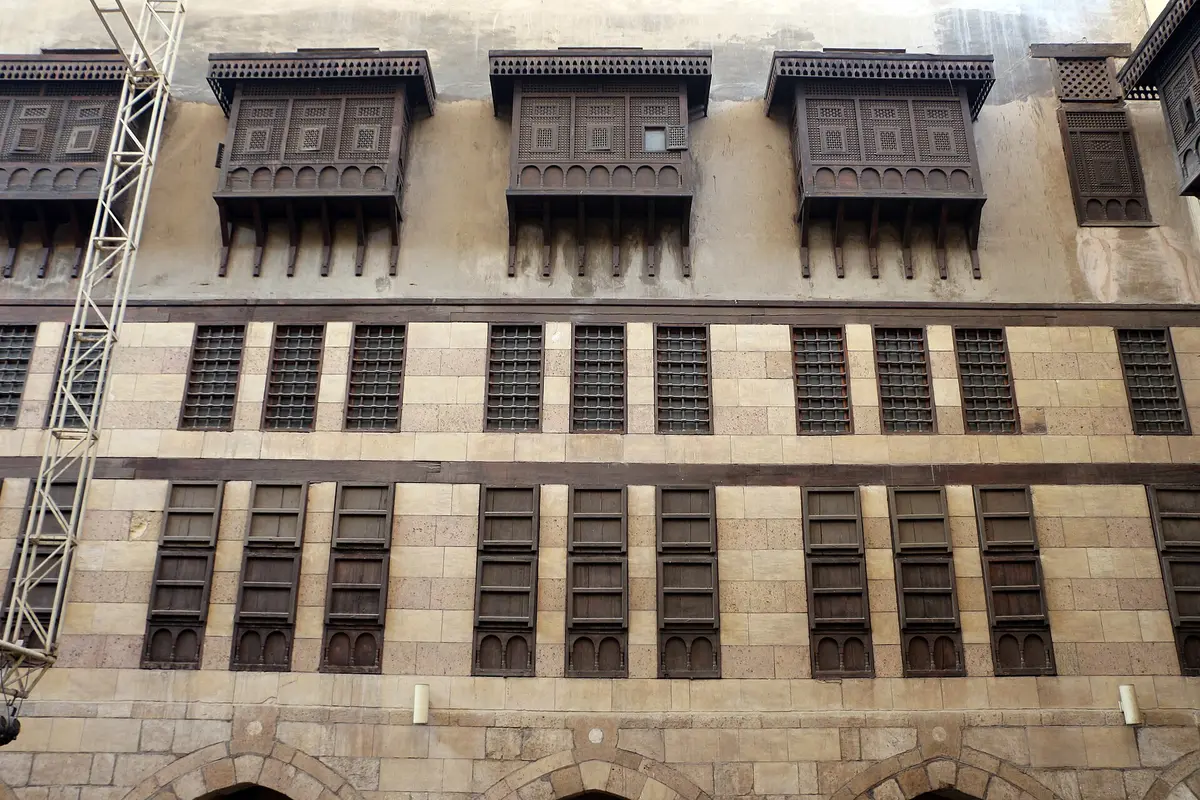
A wikala was a merchants' inn, warehouse and trading house. This one has five storeys around a rectangular courtyard. The lower floors served as warehouses and rooms for merchants, and the upper floors held lodgings. Late Mamluk woodwork, including the carved screens called mashrabiyas, survives on the courtyard walls. The same sultan built a religious complex nearby, with a mosque-madrasa, a mausoleum and a Sufi lodge. The wikala was restored in the 2000s and now houses artisans' workshops, offices and cultural shows, including Sufi whirling.
The troupe and the programme
The Tanoura troupe that performs here is described as affiliated with Egypt's General Authority for Cultural Palaces, and its shows are organised by the Cultural Development Fund sector of the Ministry of Culture. A 2020 report on the resumption of shows places them at the Ghouri dome on a weekly pattern of three evenings. A 2011 listing notes the troupe's extra concerts at the venue. That history shows a long-running public programme, and the tour you book is a visitor's way into it.
Read next: The Sufi Roots Behind Cairo's Tanoura Performance
Language, children and access
The host or greeter speaks Arabic, English, French, German, Italian, Japanese and Spanish, and the booking page has a language selector when you choose a date. The booking page shows no age limit. Still, four hours with two transfers is long for young children, and the evening is mostly outdoors. The tour is marked wheelchair-accessible, so ask the provider how that works at the venue. On photos, official advice asks you to get permission before photographing people, and the show's own policy isn't published, so ask your tour leader.
Before or after the show
The Ghuri complex has its own daytime opening hours and ticket, separate from the evening show, and the Ministry of Tourism and Antiquities lists them on its monument page. The complex stands on Al-Muizz Street, one of Cairo's oldest streets and about a kilometre long within the old walls, and the Khan el-Khalili bazaar lies across Al-Azhar Street. Because a transfer-based tour keeps to a schedule, treat the street and the bazaar as a separate visit by day, not as a stop in the same evening.
Read next: Making an Evening of Islamic Cairo Around the Tanoura Show
Who this isn't for
If you want a seated indoor theatre in all weather, this show won't suit you, because it is mostly outdoors. If you want to stroll Islamic Cairo's lanes in the evening, a pickup tour leaves little room. And if you are hoping to attend a Sufi ceremony, note that this is a folk-art performance staged largely for visitors, which is related to the devotional practice but is not the same thing.
Frequently asked questions
Where is the Tanoura show in Cairo?
At Wekalet El Ghouri, an arts centre in a 16th-century caravanserai in the Al-Azhar area of Islamic Cairo, on Mohamed Abdou Street behind the Al-Azhar Mosque. It is run under the Cultural Development Fund.
How long is the evening at Wekalet El Ghouri?
The tour is listed at about four hours: a transfer each way and about two hours at the venue. Sources give no fixed running time for the show itself. Your confirmation shows the pickup time.
What should I wear to the Tanoura show?
Dress modestly and comfortably, with shoulders and knees covered, as official advice for Egypt suggests. The show is mostly open-air, so bring a light layer for cooler evenings and wear closed shoes.
Is Wekalet El Ghouri open-air or indoors?
Mostly open-air, in the courtyard of the caravanserai. In winter the show sometimes moves to the dome, an indoor hall. You can't choose between them when you book.
Can children go to the Tanoura show?
The booking page shows no age limit. The tour takes about four hours with two transfers, and the show is mostly outdoors, so think about how younger children will manage the length. Ask the provider about specific ages.
Can I take photos at the Tanoura show?
The show's own photo policy isn't published in the sources checked. Official advice for Egypt asks you to get permission before photographing people, so ask your tour leader before you raise a camera.
Sources
- Al-Ghuri's wikala (Ministry of Tourism and Antiquities)
- Sultan al-Ghuri Complex (Ministry of Tourism and Antiquities)
- Egypt: safety and security, laws and cultural differences (UK government)
- Wikalet El-Ghouri: Ramadan Schedule (Ahram Online, 2011)
- Resumption of Al-Tanoura Troup shows in Al-Ghoury (Egypt Today)
- Al Tanourah Show (Cairo Urban Initiatives Platform)
- Wikala of al-Ghuri (Wikipedia)
- Al-Mu'izz Street (Wikipedia)